
Fire apparatus · Pumper · Rescue · Aerial · Tender
Light the scene. Not the engine.
Kraken keeps the warning lights, scene lights, radios, MDT, cab HVAC and every battery charger running on scene and at standby, so the apparatus doesn't have to idle for hours to keep them up.
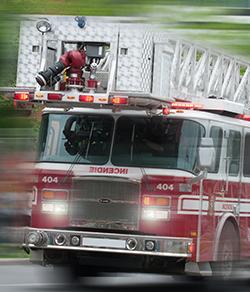
Hours on scene. Hours of idle.
An engine company can sit on scene, at a standby, at a rehab sector or in front of the station for hours. The apparatus idles the whole time because the lights, radios, MDT, cab HVAC and chargers draw from the chassis electrical system, and the batteries are only built to carry that load for a short time with the engine off. Every one of those hours burns fuel, adds engine hours and puts diesel exhaust where firefighters work and live.
- In NFPA 1901 (2016), now consolidated into NFPA 1900, the battery system must, with the engine off, provide the minimum continuous electrical load for 10 minutes without discharging more than 50 percent of the reserve capacity and then restart the engine (§13.4.2). Anything longer is the alternator's job, which means the engine has to run. Clause numbers below are from the 2016 text. This page cites them as NFPA 1900 Chapter 10 (formerly NFPA 1901 Chapter 13) and does not invent 2024 clause numbers.
- A 2015 U.S. DOE fact sheet lists fire truck and engine idling at 1.25–1.5 gal/h, plus about $600/yr in added maintenance. That is an idle rate from 2015, not a Kraken savings claim. DOE AFDC idling fact sheet (May 2015)
- DOE Clean Cities: emergency vehicles may idle for hours — sometimes for half or more of their operational time. DOE Clean Cities idling status (2015)
- IARC classifies occupational exposure as a firefighter as Group 1, carcinogenic to humans (2022). Diesel exhaust is one of the exposures it names. IARC Monographs Volume 132
- NIOSH measured diesel-exhaust components in the living quarters of two fire stations and found that air flowed from the apparatus bays into the living quarters. NIOSH HHE 2016-0094-3267
- Emergency vehicles, including fire trucks, are often exempt from laws that limit engine idling. California's commercial-vehicle idling rule exempts emergency vehicles. This page leads with crew health, cost and readiness. CARB idling ATCM
Scene power that doesn't need the engine.
- 1
Charge on the road and in quarters.
Kraken charges from the chassis charging system while the apparatus drives and from shoreline in quarters. It stores that energy in a dedicated house battery bank, kept separate from the chassis starting batteries. On US custom-cab apparatus, those starting batteries sit just forward of the pump module, under the rear of the tilt cab.
- 2
Run the scene engine-off.
At a standby, at rehab or on a long scene, the engine goes off. Kraken then carries the stationary loads on 12 V and 120 V circuits: warning lights, scene lights, radios and MDT, cab HVAC, SCBA, TIC and tool battery chargers, cord reels and rehab power.
- 3
Protect the start.
The house bank stays separate from the starting batteries, so a long engine-off standby is not the same load as the batteries the apparatus needs to restart and respond.
- 4
Pump operations still use the engine.
Kraken is not a replacement for engine-driven pumping or aerial hydraulics.
- 5
Reduce the shoreline's job.
Handheld and SCBA batteries on the hub stay charged on the road, which can reduce how often the station shoreline has to carry that charging. Shoreline power is reduced, not removed.
- 6
Sized to your apparatus.
Kraken's engineering engine sizes every system against the equipment you carry and the scene and standby time you need to cover. You spec it in the builder and get a proposal and drawings.
Kraken does not claim to be NFPA 1900 or NFPA 1901 compliant. Those standards apply to the finished apparatus, which the final-stage manufacturer certifies. The system is designed to work alongside the apparatus low-voltage alarm and load management, not in place of them.
Better for the department. Better for the crew.
For fire chiefs, fleet managers and apparatus committees
- Idle hours on standby can become engine-off hours.
- Less diesel exhaust where firefighters work and live.
- The house system carries stationary loads so the chassis electrical system is not asked to do it all at idle.
- Save a builder configuration and carry it from unit to unit, or into the next apparatus spec.
For crews
- Less exhaust on scene and in the bay.
- Radio traffic and face-to-face communication without an engine at idle next to you.
- Handhelds, SCBA batteries, thermal imaging cameras, flashlights and battery tools stay on charge.
- Cab HVAC and rehab power on a long incident without running the truck for those loads.
See it sized for your apparatus.
Enter the loads you run on scene and at standby. The builder sizes a system package for your apparatus and draws it.
What Kraken powers on the apparatus
| Load | Typical circuit | Notes |
|---|---|---|
| Warning lights | 12 V DC | Minimum optical warning while blocking the right-of-way. |
| Scene lights | 120 V AC | Floods and brow lights. |
| Radios and MDT | 12 V DC | Always on. |
| Cab HVAC | 120 V AC | Cab or body heating and cooling while parked. |
| SCBA, TIC, handheld and tool chargers | 120 V AC | Battery chargers on the apparatus. |
| Cord reels | 120 V AC | Tools and lights away from the truck. |
| Rehab power | 120 V AC | Fans, misting or heaters for the rehab sector. |
| Pump-panel accessories | 120 V AC | Engine-driven pumping itself is not engine-off. |
| Scene tools | 120 V AC | Saws and fans. |
Kraken's engineering engine sizes every system against the equipment and scene or standby time you enter. Actual capability depends on your configuration. Runtime, fuel savings, weight and noise are not published here.
Spec your apparatus system in minutes.
Pick Fire apparatus in the Kraken builder. The scene and standby loads come pre-filled. Adjust them, and the engine sizes a Good / Better / Best package with drawings on a US pumper or aerial side view, with the starter bank shown just forward of the pump module under the rear of the cab.
Questions
Can the apparatus pump with the engine off?
No. Engine-driven fire pumps and aerial hydraulics still need the engine. Kraken carries the stationary electrical loads around them.
How long can we stay on scene engine-off?
It depends on the apparatus, the equipment, the weather and the incident. The builder sizes the system to the scene and standby time you enter. A published runtime for a reference configuration is not on this page.
Will it drain the starting batteries?
The house bank is separate from the starting batteries. This page does not claim an auto-start or a specific interaction with the apparatus low-voltage alarm.
Does it replace the NFPA-required alarm or load manager?
No. Those belong to the apparatus and its final-stage manufacturer.
Isn't fire apparatus exempt from anti-idle laws?
Often, yes. DOE notes that emergency vehicles are often exempt, and California's commercial-vehicle rule exempts them. Departments cut idling for crew health, fuel and maintenance.
How does it recharge?
From the chassis charging system on the road and from shoreline in quarters. A recharge time is not published here.
How much fuel will we save?
A savings figure is not published. The DOE figure of 1.25–1.5 gal/h (2015) is an idle rate, not Kraken savings.
What does it cost, and who installs it?
Pricing depends on configuration. Build your system online or talk to a Kraken rep.